During the summer season, the volume of customers moving through Martha’s Vineyard businesses compresses what would be a year’s worth of foot traffic on the mainland into roughly fourteen weeks. A restaurant that serves eighty covers on a slow November night may serve four hundred on a Saturday in August. That concentration creates a proportional increase in pathogen exposure on every surface customers and staff touch throughout the day.
A commercial disinfecting service addresses the microbial dimension of that traffic that standard cleaning cannot. Understanding what disinfecting actually involves, how it differs from regular commercial cleaning, and how to structure it for peak season gives businesses a practical framework for protecting both their customers and their reputation.
Cleaning versus disinfecting: an important distinction
These two terms are often used interchangeably, but they describe fundamentally different outcomes.
Cleaning removes visible soil, grease, and debris from surfaces using detergents and mechanical action. It improves appearance and reduces the organic material that pathogens need to survive, but it does not achieve measurable microbial reduction on its own.
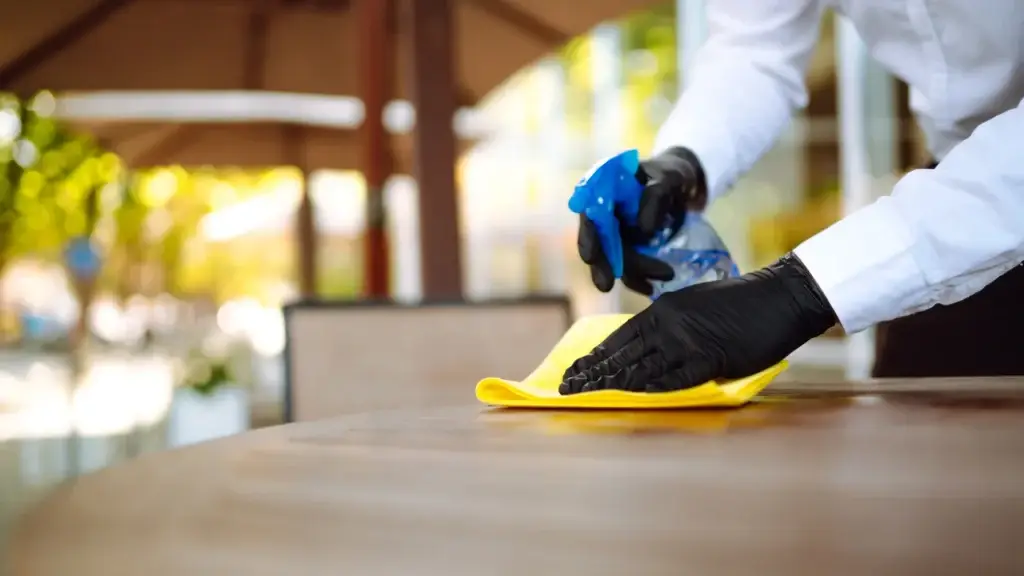
Disinfecting uses EPA-registered chemical products to reduce pathogen populations on pre-cleaned surfaces to levels defined by the product’s laboratory-tested kill claims. A surface must be cleaned before disinfecting, because organic material on the surface inactivates many disinfectants before they can work. The sequence is cleaning first, then disinfecting.
The EPA’s registration process for disinfectants requires manufacturers to demonstrate, through standardized testing, that a product achieves specific log reductions against defined pathogens when used at labeled concentration and contact time. Products on EPA List N are registered against SARS-CoV-2. Products on EPA List Q are registered against norovirus. A commercial disinfecting service that uses registered products, at confirmed concentrations, and observes the required dwell time is a meaningfully different service than one that sprays a general-purpose cleaner and wipes it immediately.
The dwell time is the variable most often skipped in non-professional applications. Most EPA-registered disinfectants require one to ten minutes of visible surface wetness to achieve their registered kill claim. Applying and immediately wiping a product does not disinfect, regardless of the product’s quality.
Why peak season on Martha’s Vineyard creates elevated pathogen risk
The island’s summer season draws visitors from across the country and internationally. That population diversity, compressed into a small geographic area with shared commercial spaces, creates conditions where respiratory and gastrointestinal illnesses can move through the visitor community quickly.
Norovirus, the most common cause of acute gastroenteritis in the United States, is particularly relevant for food service businesses. It is highly transmissible on surfaces, survives on hard surfaces for days without disinfection, and requires a very low infectious dose, meaning very few viral particles are needed to cause illness. The CDC estimates that norovirus causes 19 to 21 million illnesses annually in the United States, and food service environments are among the most common transmission settings.
A single gastrointestinal outbreak traced to a restaurant or food service operation carries consequences that extend well beyond the immediate health impact: regulatory inspection, potential temporary closure, and reputational damage in a close community where word travels fast and reviews are read by the following summer’s visitors before they book a table.
Staff illness presents a separate operational risk. Replacing a sick employee on an island with limited seasonal housing and labor availability is considerably harder than on the mainland. Staff absence during peak July and August weeks, when hiring a replacement is nearly impossible, forces reduced hours or service gaps at the worst possible time.
What a professional commercial disinfecting visit covers
The scope of a commercial disinfecting service on Martha’s Vineyard is structured around the surfaces that carry the highest transmission risk in each type of business. The priority surfaces are those contacted by multiple people throughout the day without routine cleaning between contacts.
Entry and reception areas: Door handles, push plates, reception counters, and shared waiting area surfaces receive EPA-registered treatment at every visit. Entry points are both the first customer impression and the first transmission risk.
Restrooms: Every contact surface is treated on a systematic cycle. Toilet handles and seat hinges, faucet handles, soap and paper towel dispensers, door handles, and any other contact point are disinfected completely. Restrooms receive the highest disinfecting frequency of any area because the pathogen contact risk is direct.
Transaction and service surfaces: Payment terminals, service counters, shared pens and styluses, menus, and any surface involved in a customer transaction are disinfected after each service period. In food service environments, all food-adjacent surfaces are treated in compliance with applicable food code standards.
Employee common areas: Staff break rooms, shared kitchen surfaces, appliance handles, and meeting areas are frequently overlooked in commercial disinfecting plans despite being a primary internal transmission vector. When illness enters the staff group, it typically spreads through shared employee spaces before it affects customer-facing areas.
Workstations and back-of-house: Shared workstations, multi-user equipment, and storage areas with regular staff access are included in the scope based on the business type and the frequency of shared contact.
How to set the right disinfecting frequency for your business
The appropriate schedule depends on four variables: business type, daily customer volume, hours of operation, and the physical layout of the space.
For food service businesses during peak season, daily professional disinfecting of all high-touch surfaces is the standard. This is typically structured in combination with the nightly commercial cleaning visit, with disinfecting integrated into the scope rather than treated as a separate appointment.
For retail operations, a minimum of three professional disinfecting visits per week during summer, combined with staff-applied disinfecting of payment terminals and door handles between visits, provides a consistent baseline. Higher-volume retailers benefit from daily treatment.
For professional offices and service businesses that receive client appointments, weekly professional disinfecting during peak season maintains the standard clients expect and that insurance or licensing requirements sometimes formalize.
The most important scheduling decision is making it before the season opens. Commercial service availability on Martha’s Vineyard during July and August is limited. Businesses that confirm their cleaning and disinfecting arrangements in April or May have access to the providers and schedules they need. Those that approach the same providers in late June often find their preferred options are fully committed.
Integrating disinfecting with the broader commercial cleaning plan
The most effective commercial hygiene approach combines daily maintenance cleaning with scheduled professional disinfecting rather than treating them as separate programs.
Maintenance cleaning removes the visible soil and organic material that interferes with disinfectant efficacy. Professional disinfecting addresses the microbial load that cleaning alone does not reduce. The two components depend on each other: cleaning without disinfecting leaves pathogens on a visually clean surface; disinfecting without prior cleaning reduces efficacy because organic matter inactivates the disinfectant before it can work.
For businesses that have an existing commercial cleaning service relationship, adding a confirmed disinfecting scope to that arrangement is simpler and more reliable than managing two separate vendors. The cleaning team’s familiarity with the property applies to both functions, and coordination between cleaning and disinfecting steps is managed internally rather than across different providers.
Businesses that need both daily maintenance cleaning and peak-hour surface management may also benefit from evaluating a day porter service for the hours when customer volume is highest and a disinfecting refresh between service periods is most valuable.
What businesses get wrong about commercial disinfecting
Several misunderstandings about disinfecting are common among business owners who have not worked with a professional commercial hygiene service before.
The most common is confusing cleaning product with disinfectant. Many businesses use all-purpose cleaners labeled as “antibacterial” or “sanitizing” as though they are equivalent to EPA-registered disinfectants. They are not. The regulatory bar for an EPA-registered disinfectant is significantly higher, and the required contact time and product concentration are not replicated by general-purpose cleaning products.
The second is ignoring dwell time. A disinfectant that requires four minutes of wet surface contact, sprayed and immediately wiped, achieves minimal microbial reduction regardless of the product’s label claims. Professional teams are trained to apply, allow the required dwell, and then wipe. This step cannot be rushed.
The third is focusing exclusively on visible areas. Back-of-house surfaces, employee break rooms, and storage areas with frequent shared contact are equally important to disinfect. Pathogens do not limit themselves to customer-facing spaces.
Responding to illness: adjusting the disinfecting scope reactively
When staff members report gastrointestinal symptoms during the season, the probability that norovirus or a similar pathogen is present in the environment increases immediately. The appropriate response is rapid adjustment of the disinfecting scope and frequency, not waiting to confirm a diagnosis.
Increasing restroom and common area disinfecting to twice-daily treatment, switching to products with confirmed norovirus kill claims if not already in use, and temporarily increasing HVAC filter maintenance to address any aerosolized particulate are the standard reactive steps.
A commercial cleaning provider experienced in infectious disease response protocols can implement these adjustments on short notice. A generalist cleaning service without this background cannot. The distinction becomes consequential when a reactive response is needed quickly during a busy week.
Frequently asked questions about commercial disinfecting service on Martha’s Vineyard
What surfaces require disinfection rather than cleaning alone?
High-touch surfaces with multiple daily contacts require both cleaning and disinfecting: door handles, payment terminals, restroom fixtures, shared tools, counters where customer transactions occur, and any surface contacted by staff and customers without cleaning between contacts. Surfaces with infrequent contact, such as storage shelving or structural elements, require cleaning but not necessarily regular disinfection.
How do I know if a cleaning service is actually disinfecting or just cleaning?
Ask for the specific products used by name, their EPA registration numbers, and the dwell time applied during each visit. A professional commercial disinfecting team can provide this information readily. If a provider cannot identify the products they use or is unaware of required dwell times, they are applying cleaning products rather than registered disinfectants, regardless of what they call the service.
Is disinfecting required by law for Martha’s Vineyard food service businesses?
Massachusetts food safety regulations, enforced under 105 CMR 590.000, require that food contact surfaces be sanitized, not just cleaned, after each use. Sanitizing is a regulated term that requires measurable pathogen reduction, similar to disinfecting in its requirement for registered products and contact time. Non-food-contact surfaces in food service environments must be cleaned regularly but are not subject to the same mandatory sanitizing frequency. Professional guidance on which surfaces fall into which category is part of what a qualified commercial cleaning provider should offer.
Can a business self-manage disinfecting between professional visits?
Yes, and it is recommended. Staff-applied disinfecting of the highest-contact surfaces, such as payment terminals, door handles, and restroom fixtures, between professional visits maintains the protection level between scheduled service appointments. The professional visit provides the systematic, thorough treatment across all identified surfaces; staff-applied maintenance fills the gaps during business hours. Using registered products at correct concentration, with proper dwell time, is required for the staff application to be effective.